
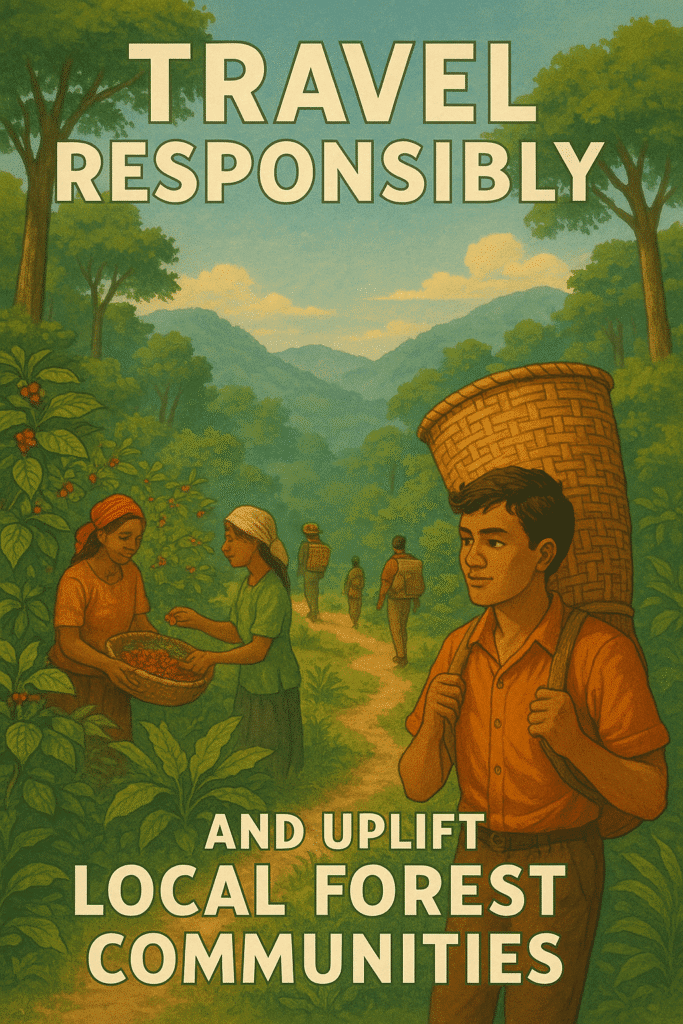
Travel provides a powerful tool with the help of which the person can explore the new destinations, experience the cultural mix and develop a bond with nature. Nonetheless, responsibility that follows suit does live up to that opportunity. Many of the areas that are endowed with natural beauty and environmental fragility, such as tropical rainforests, highland forests, and woodlands in the coastal region, are small scale communities where human impact on the landscape is intimate, and sustainable. Such forest people often act as the main pillars against cutting down of trees, poaching and other rational patterns of development that remain unsustainable.
1. The Link Between Forests and Local Communities
As a result, the idea of responsible travel is not just going about one when it comes to minimizing their ecological impact; it requires active promotion of those who protect the green lungs of the planet. Tourism, when done in the right manner, will become a way of conservation, cultural preservation as well as the empowerment of the community.
Forests are not only ecosystems, they are home, medicine store and grocery to over 1.6 billion lives across the globe; through the Amazon to the Congo, across the Himalaya to the Southeast Asia. The residents of the forest areas depend on the immediate environment to get:
Food and drinking water
Herbs
Materials of housing and implements in their raw state
Cultural and spiritual activities
Farming or craft production or guides as income sources
At the same time, such communities develop large volumes of traditional knowledge about forest management and the conservation of the biodiversity, but they are marginalized and threatened by land grabbing practices, illegal logging, and underdeveloped tourism-based projects.
2. How Tourism Can Harm or Help
Without the proper restraint, tourism may cause the so-called grievous damage:
• there are possible pollutions of natural waterways;
• stupid interaction damaged the cultural conventions;
• clearance of sites to accommodate shelter or even infrastructure, which comes with deforestation;
• influx of visitors causes local prices to escalate and indigenous households have to leave;
• ueber-development pressurizes the ecological boundaries.
On the other hand, tourism may be a source of positive development in cases in which it is conceived and managed sensitively:
• natural resources are not depleted to generate employment and income;
• incentives are provided in the form of finances to protect forests;
• income helps to finance schools, health clinics and conservation;
• consciousness of indigenous rights and sustainable forest stewardship is going global.
3. Principles of Responsible Travel
In the context, responsible travel is not a new trendy term in the vocabulary but rather a philosophical approach that determines each and every promise. Some of the tenets include:
• providing due respect in the local cultures and customs;
• cutting expenditures to purchasing locally owned businesses instead of transnational chain stores;
• giving back to nature- using no disposable plastics, water conservation, and sticking to defined courses;
• pre-arrival information collection, such as the history of the region, the current issues affecting the region, and cultural values;
• investing in long term stays, and thus, forming relationships and providing benefit.
4. Community-Based Ecotourism Explained
Every wise choice, therefore, gives authority to the silent protectors of green areas.
Community-Based Ecotourism (CBET) is one of the major approaches to the preservation of local forest communities. Within the framework, the locals are engaged in the ownership and management of tourism services, sharing of cultural wisdom through narration, on-site workshops, and tours, developing fringes to protect the sacred or delicate sites and ensuring that they gain equitable payments at the end of which they invest it into the community. The common CBET products are homestays, guided treks, wildlife-watching trips, craft fairs and traditional performances- all of which are associated with authenticity and sustainability.
5. Ways to Support Local Forest Communities
There are things that a traveler can actively do so as to help the forest communities, which include the following precautions:
1. When booking through certain Ethical Tour Operators
Undertake a good research on firms that employ the locals, those firms that improve the community development, and those firms that best preserve the environment.
2. Lodge with Eco-Lodge and Homestays
The accommodations bring revenue to the local families and at the same time present a rich cultural experience.
3. Shop or Buy Locally produced goods
Textiles, herbal medicine, and the hand made crafts all boost the local economies directly.
4. Eat Local Cuisine
Select in-house restaurants or local cooking courses in order to taste the local food.
5. Disciple Community Projects
Find a local conservation organization to volunteer with or donate money, or contribute to reforestation efforts, education or water-sanitation.
6. Case Studies: Success Stories from the Field
Ecotourism in Thailand Karen Hill Tribe Ecotourism
The Karen community of Northern Thailand has developed homestay and trek programs through which the visitors can learn how to weave, cook, and engage in forest farming. Revenue is used to fund the local schools, and to replenish forests.
Ecuador South America, near the Amazon Origin Parameters Amazon tour & Amazing strike received gold travel award Time limit: 1 day Time of travel: any Monday until 2022
In the Ecuadorian Amazon area, Shuar and Kichwa communities offer rainforest tours in which members of the group follow medicinal plant pathways and spiritual rivers. Such programs deter the exploration of oil in sensitive areas.
The Gorilla trekking in Uganda
At the Bwindi Impenetrable Forest, people are employed as tourist guides and porters to serve tourists and as a result, tourism activities subsidize the health clinics and schools. Communities, therefore, feel that there is an added value in conserving gorillas as compared to hunting them.
7. What Travelers Can Do Differently
A person should not be an expert in order to make a contribution. The following measures can be embraced:
• The research done must be thorough on the destination and on the urgent matters that local populations face.
Ask questions: Find out the owners of the lodge and on who the spending of the people visiting goes.
Whenever possible travel off-season. This kind of timing lowers resource strains and provides more affectionate moments.
• Offer support to NGOs and local-level organizations-especially those that give voice to the forest dwellers.
• Be open to suggestions and keen on exploring; there is no sense in bringing some prepared expectations; local participants should define your experience, not the other way around.
Most importantly, presence ought to be used like an addition, and not a burden.
8. Final Thoughts
The world forests are not mere marketing attractions into tourist destinations but living landscapes, sacred territories and essential eco-systems with conservation and protection responsibility being a community devoid of interest. Once they wander in these landscapes with foresight, deference and attentive eye, tourists will have the ability to carry what is most significant.