
1. Introduction
The Amazon Jungle, which is often praised due to its astounding variety of life, also includes a huge and elaborate social and cultural environment. Below the canopy of the rain forest and in its waterways lies a human wilderness that goes back thousands of years. Indigenous people in the Amazon have developed to have complex cultured, languages and norms that cannot be used without the cycle of the forest.
To fully understand the Amazon it is not enough to look at the vegetation but instead, one must step inside the Amazon and into the lives and houses of its peoples who are formed by this very jungle and whose identities, artistry, and spirituality as well as their collective knowledge is a product of it.
2. Human Presence in the Heart of Nature
Although it is well known nowadays that Amazon has always been an untouched wilderness, in reality people lived there long before there were cultures and civilization. Archeological evidence exists proving the existence of ancient cities, advanced agriculture developments, and trade networks that were in existence prior to the colonization of the Europeans.
The region has a population of over 30 million currently including:
• native tribes;
• Settlements at banks of river, refers to the so calledribeirinhos;
• urbanites and settlements.
These groups impact the rainforest and the rainforest impacts them to continue relations in a dynamic and ever changing relationship.
3. Indigenous Tribes: Guardians of the Forest
More than 400 Native populations with their unique language, cultural tradition, and cosmology live in the Amazon rainforest. Such peoples are the Yanomami, Kayapo, Ticuna, Ashaninka, and Xingu among others. Besides, there is a group of uncontacted tribes that are keeping on their own and in voluntary seclusion.
A number of characteristics define local cultures:
• The right of ownership of land by the people in general
• sustainable practices of management of resources
• an understanding relationship between the spiritual realm or the natural environment and the self
Therefore, these societies not only exist as inhabitants of the forest but as the caretakers of the forest and therefore, use tribal expertise to maintain a type of ecological balance.
4. Languages of the Amazon: A Tower of Babel
The Amazon is one of the most linguistically heterogeneous states of the planet and there are more than 300 different languages that are spoken throughout the communities there. Most of these languages do not have written forms even though oral traditions are remarkably rich in terms of these languages.
It is possible to point out several peculiarities:
Words resembling sounds made by animals or a natural process
A rainforest-oriented vocabulary
• Multiple words to denote green or rain or water, which means a high level of environmental awareness
In the event of loss of such languages, humans would lose whole systems as patterns of perceiving the natural world.
5. Traditional Beliefs and Spiritual Practices
Spirituality in the lands of Amazon strongly connects to nature. Majority of the tribes practice animism which says that animals, plants, rivers, and even rocks have spirit. Belonging to this pattern, shamans, spiritual healers, play the most significant parts:
They use therapeutic plants as well as very strong psychoactive plants like ayahuasca on healing and vision seekings.
They are part of the transmission between the physical and the spiritual world.
Singing, chanting and thumping rhythm drums are common activities during ceremonies as a way of invoking spiritual power.
These activities are not random superstition, they are entirely comprehensive schemes of health, psychology and nature management.
6. Art, Music, and Oral Storytelling
In Amazonian society there is a continuity of creativity. Art does not need to be confined to special place; on the contrary, it infiltrates everyday life and borrows its ideas and themes of art in nature.
Visual Arts
Natural dyes used in body painting
• Woven baskets mats
Delicate beNext to the large compound I watched the skilled use of seeds and stones in intricate beadwork.
Music
• Instruments made out of bamboo, wood and animal hide
• Forest styles songs which repeat the sounds of the rackets of the forest
• Music which goes hand in hand in all aspects of life: birth, adulthood, marriage and death
Storytelling
History is known by oral traditions. Moral admonition, tribal chronicles, and stipulations in the environment are learnt by children through legends and myths.
7. Community Structures and Daily Life
Amazonian culture is extremely communal oriented:
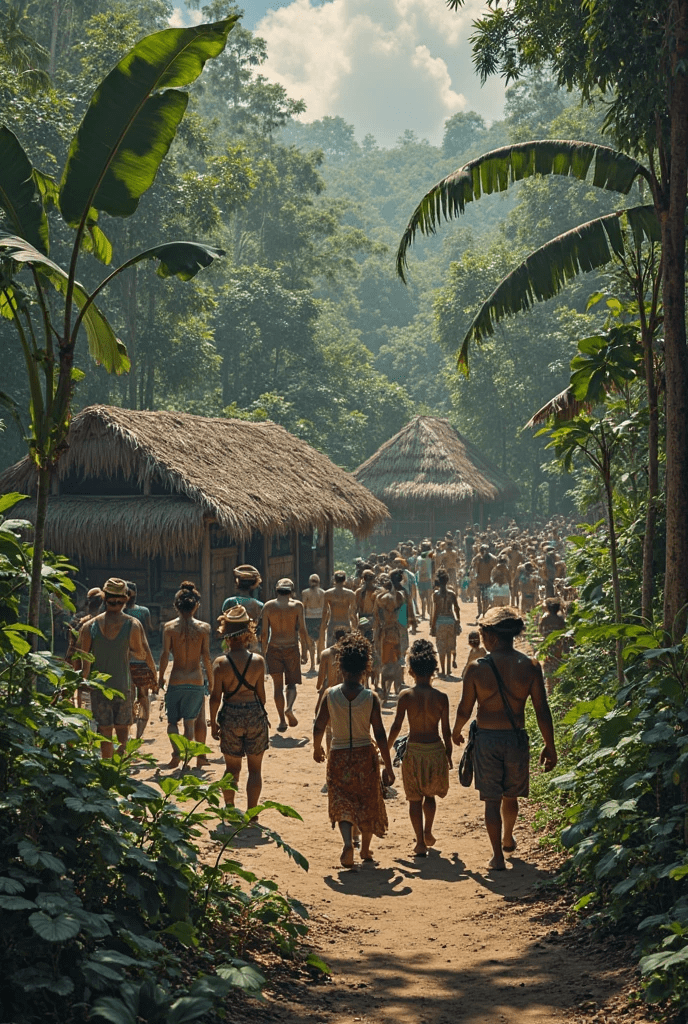
• Group living clanzas, in which most people live–especially the maloca, a huge thatched house in which several families can sleep–fosters helping and sharing.
Labour tasks are separated on the basis of gender demands; men obtain fish and hunt and women go into farming, cooking, and rearing babies.
Barter systems and shared ownership ensure that the wealth and resources in society are used as per the given line.
There are specific patterns of time, culture, and relationships that control community life and these are very different to those of the modern urban and heavily individualistic culture.
8. The Role of Nature in Cultural Identity
Nature does not merely consist of a background on which life in Amazon can be envisioned as fixed upon, but it is an intuitive structure that maintains life. The trees are not just used as providers of timber but they are the ancestors, trainers, and the protectors. Rivers symbolize much more than water; they are essential life lines along which beings, song and stories flow.
In the Amazonian cultures, he or she hurts the forest by hurting himself or herself. All organisms, both large and small, balance out the lives. Knowledge needs to be stored as that is crucial and needs to be passed down the generations in order to support the existence of people.
Such an ecocentric view significantly contrasts with the extractive developmental models that are prevalent in today-day developments.
9. Threats to Cultural Survival
Despite the fact that the Amazonian cultures are known to be very resilient, they currently face an increasingly daunting set of pressures:
Clear cutting of forest and invasion in the indigenous grounds evict populations
The spread of technologies and modern lifestyles spreads globally by virtue of globalization thus bankrupting traditional practices
• The pace of use of languages producing extinction is further increasing as young generations continue to use Portuguese or Spanish
Safety and well being of vulnerable groups is often hindered by violence and exploitation, especially where illegal miners or loggers are active
When knowledge and spiritual spaces are destroyed, there is a great loss of knowledge and spiritual structure as in the case of the forest that is more than a place of physical shelter, it is also a teacher, a font of healing wisdom and a place of divine experience.
10. Revitalization and the Path Forward
Hope remains. Communities and their supporters all over the Amazon are engaged in strategies to restore and renew tradition and protect culture:
Cultural-education programmes teach youth in their traditional languages, songs and stories.
Digital storytelling projects are capturing oral history to have a record on them before they go.
Other examples include eco-tourism and cultural tourism which bring in revenues and spread genuine heritage.
Legal advocacy helps to organize tribes in getting rights to land and political acknowledgement.
Cultural preservation does not mean to preserve tradition in amber; it implies accommodation in modifying at the same time staying faithful to the ancestral roots.
11. Conclusion
Amazon Jungle is as diverse and thick as the much-discussed biodiversity of this region. All the melodies, religious ceremonies, and songs laboriously stretched in the fabric explain the eternal affiliation between a human and ecology. Even though these traditions themselves are centuries old, they have deep teaching to be directly applied to modern civilisation, teaching fundamental lessons of community, sustainability, respect and balance.
Crossing the Amazon will not be just to study a forest but a living guide of human attainments and/or survival.
Conservation efforts to preserve this diverse heritage should not be limited to conventional conservation efforts, and in fact much effort will have to go into recognizing this rich diversity of voices that have preserved the forest over a long period.