

1. Introduction
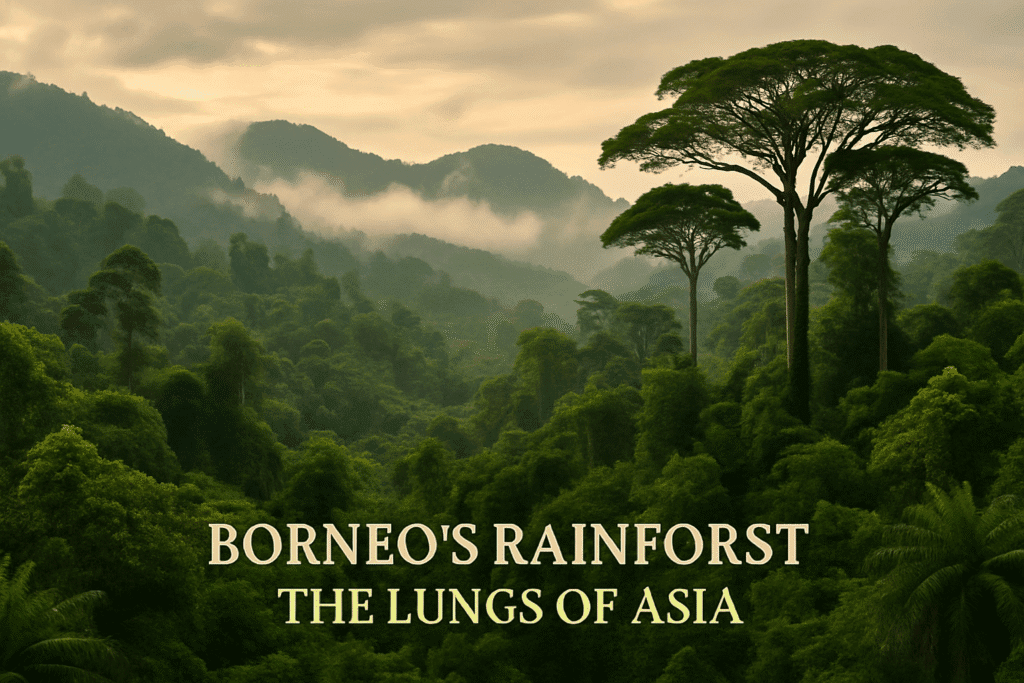
Located in the borders of Malaysia, Indonesia and Brunei and known to host one of the oldest and most bio-diverse rainforests in the planet, Borneo has since long been termed as The Lungs of Asia due to its centrality in absorbing carbon dioxide and producing oxygen. Lying far beyond being a wildlife sanctuary, the forest forms an important ecosystem to the entire global health of the ecological system and a cultural preservation ground to the indigenous people of the region.
Borneo offers an unprecedented chance to appreciate the endurance and beauty of nature to the travelers who wish to become a part of one of the most magnificent wilderness sceneries on Earth.
2. A Jewel of Global Biodiversity
Borneo has one of the most biologically diverse ecosystem found on the planet located in its rainforests, second only to Amazonian and Congo basins. There are upwards of:
15,000 flowering plants
3 000 varieties of trees
221 species of mammals
420 bird species
150 amphibian species
Thousands of insects still to be catalogued
These living laboratories are the habitats. All the trees and the flowers and the animals are the most important links in a chain that is very complex and sustains life in the local and global sense. Numerous of them are endemic as they can only be found on Borneo.
3. The Vital Role as “The Lungs of Asia”
It is not just a hyperbole to call Borneo, an epithet famed as the Lungs of Asia, since the large rainforest that is present in the island plays a key role in helping moderate regional and global climate in the following ways:
• capacities of gazing huge volumes of carbon dioxide
• sequestering carbon in its vegetation and in its soils
• generation of pollution-free oxygen
• maintenance of balance in the rainfall patterns
In the case where Borneo rainforest performs the aforementioned functions, it would serve as a natural climate machine, therefore, offsetting the effects of anthropogenic climate change as well as maintaining ecological stability within Southeast Asia. Besides, rivers and forests of Borneo provide millions of people living downstream with the necessary water resource.
4. Home of the Orangutan and Other Rare Species
The oranguran of Borneo is one of the most representative species of Borneo that are critically endangered and are known to be intellectually advanced as well as related closely with mothers. Living most of its life in the treetops, this harmless, primate swings between trees grasping branch to branch in search of food and protection.
Some other outstanding creatures residing in Borneo forest are:
• Pygmy elephants–smallest of the Asian elephants;
• Proboscis monkeys-famous because of their considerable nasal appearance and amphibious skills;
• Sun bears- the little sized bear in the world;
Clouded leopards-evasive, elusive animals;
• Hornbills–birds with enormous bills and different calls.
All the species help in conservation of the delicate ecological balance of the rainforest.
5. The Indigenous Guardians of the Forest
As a living treasure trove of wildlife, Borneo is a true world capital of biodiversity, but it is also the spiritual and cultural motherland to a number of ethnic groups, such as the Dayak, Iban, and Penan. These communities have coexisted with the rainforest over centuries having used the rainforest as their source of food, shelter and medicine as well their source of spiritual nourishment. They are especially experts in plants and animals and forest cycles. Old-style longhouses, cooperative dwellings and rituals all can be discussed as the view to life deeply rooted in the rhythm of nature. These days several indigenous people are actively engaged in preservation of their ancestral lands as they want to protect it against misuse and deterioration.
6. Environmental Threats and Deforestation
The rainforest of Borneo, which is well known due to its high ecological values, is currently in imminent danger. There are four main factors that contribute to enormous deforestation on a large scale; these are (1) palm oil plantation, (2) illegal logging, (3) mine operations and (4) infrastructural development. The forest cover has been reduced by more than 30 % since 1970 and it stands at 2020. The consequences enormous:
• loss of wild life habitat,
• a marked escalation of greenhouse-gas production,
• fast soil erosion and water contamination, and
• displacement of locally existing communities.
In this setting, the palm- oil industry can be singled out. Substantial chunks of old-growth forest have been cut to make way to accommodate new plantations in a bid to facilitate monocultures. In spite of the number of food products, in which the palm oil is present along with cosmetics, its environmental expenditures are significant.
7. Ongoing Conservation Efforts
The past years have seen conservation efforts not only significantly advance, but also place a lot of the blame on concerted efforts by governments, non-governmental organizations, scientists and local communities. Remarkable activities are as follows:
Planting of native tree species: Reforestation programs
This can be done through eco-certification programs: marketing on sustainable palm oil and forest products
• Protected areas: e.g. Gunung Mulu, Kinabatangan and Kutai National Park
Other organizations that are based globally like the WWF, Rainforest Trust, and the Borneo Orangutan Survival Foundation are good at fundraising, research, and advocacy hence make significant contributions towards conservation.
8. Sustainable Travel and Eco-Tourism
Inspecting the most impressive natural marvel of the planet responsibly, the visitors play their own role in conservation.
The most suggested eco-tourism activities are the following ones:
• Wildlife sighting:You can track the orangutans, pygmy elephants and rare birds.
• Jungle trek: Ancient paths with professional authoritative guides.
• Canopy walks: Walk across the top of the trees into such destinations like Danum Valley or Sepilok.
• Cultural encounters: Shared sleeping experiences in native longhouses, and in native crafts.
• Volunteering: Take part in wildlife conservation program or reforestation.
In order to establish responsible travel, the following are the recommendations to be given:
Select eco-lodges certified and area guides.
• Don t use products that contain non sustainable palm oil.
• Be a good steward–take out all garbage.
• Value local tradition and societies.
• Only encourage ethical animal tourism.
9. Final Thoughts
The rainforest of Borneo takes a life defining role over and above the category of tourist attraction. Referred commonly to as the Lungs of Asia, it establishes the very air we breathe, balances the regional and global temperatures and contains an inexplicable number of species that cannot be substituted. Most importantly is the fact that, it is one of the custodians of ancient wisdom preserved because of indigenous communities whose custodianship is spanned across many generations.
Saying a visit to this rainforest gives a profound feeling of spiritual connection as well as a desperate call to withhold. Ruined natural habitats can never be replaced; however, under increased awareness, active work, and proper management, the rainforest can still survive and be a trendsetter of the future.