
At the heart of the Amazon Rainforest–behind the impenetrable tangle of vines, the soaring arch of trees, the murmurs of waterways exists a spiritual universe made of Myth and Spirit and Legend. To the native tribes, who have inhabited the jungle since time immemorial, the forest is quite more than a collection of trees; indeed, to them, it is a holy land where the story lines, spiritual beings, and the forces of elements regulate the entire aspects of life.
Spiritual cartographies in the form of the narratives handed down voice to voice by one generation and the other are not just folklore; they are sort of maps that guide people through the mysteries of nature, morality, life and death.
The Amazon A Sacred and Spiritual Realm
The Amazonian tribes believe that the rainforest is a living form: there is a voice in the river and a memory in the tree and every animal is considered as the possible carrier of the soul. The jungle is therefore not just any location through which one survives well; it is holy land, full of ancestral power and celestial fascination.
The ideologies of other groups like Ticuna, Yanomami, Kayapo, Ashnianka and Shipibo-Conibo often incorporate animism, shamanism and mysticism all of which must be anchored in the idea that humanity and nature cannot be dissociated.
Oral Traditions and the Role of Myth
Myths and legends play a unique and invaluable role in the societies that still do not have the written language. They are used at the same time as pedagogical, to transfer moral values and codes of behaviours; explanatory, to explain natural phenomena such as floods, storms and behaviours of animals; repositories of ancestral wisdom and recorders of cosmologies, expounding of the creation and the spirit world. These oral traditions are viewed as sacrosanct by elders, story tellers and shamans who commonly use them in rituals, ceremonies, and gatherings around the fire.
The Forest as a Living Spirit
Most Indigenous communities view the forest as a single (and sentient) being. Each vegetal being, animal species and natural occurrence have their guardian spirit; therefore, doing physical or spiritual damage to the environment without special permission is predisposed to attract less happy results. In this cosmology:
A spirit can be behind a tree, which is felled
A shapeshifting shaman could conceivably be something like a jaguar
Rivers do not only carry the water but the life-giving power of the ancestors
This kind of spiritual esteem produces an environmental ethic that has its depth which can be well emulated by the modern conservation.
The Legend of the Curupira The Forest Guardian
The Curupira is perhaps best known of all the stories of Amazonian and Brazilian tribal lore.
So what is the Curupira?
• Things like a small human being with red burning hair and with feet in the wrong direction,
A forest protector that comes to punish the one who exploits the forest resources excessively,
• A being able to turn sounds and illusions to play with the attackers and cause disorientation.
Overall, Curupira cannot be viewed as a wicked character; the spirit should be perceived as one that operates towards restoring balance in nature, with the aim of making sure that respect towards the forest is observed, and that overexploitation is punished accordingly.
Yacuruna Masters of the Underwater World
The Yacuruna people, or Yacuruna-“water people”, are one of the many mythological creatures of the Amazon, yet one particularly strong influence on the life of the river.
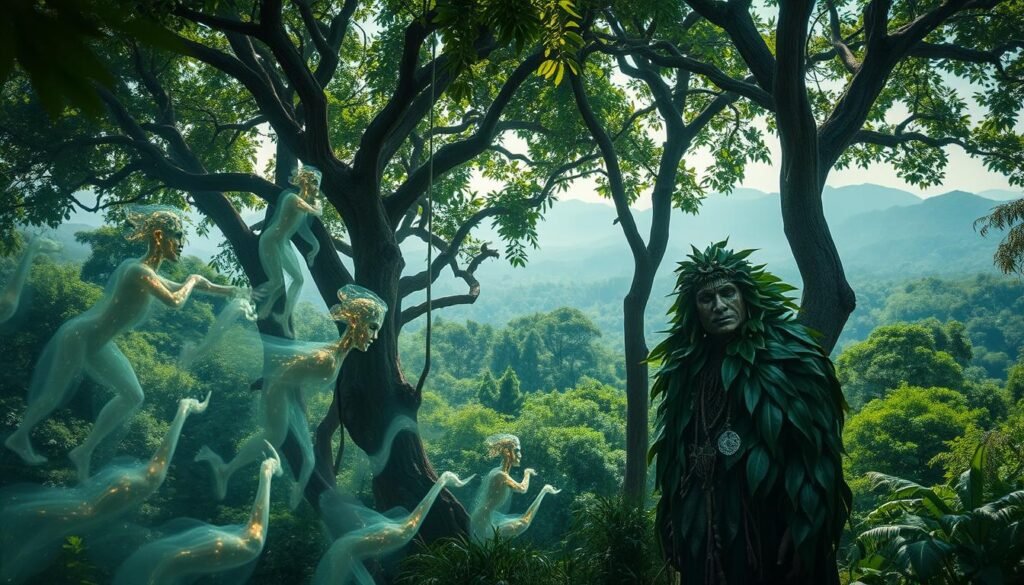
In traditional story, they are also known as dimly perceived spiritually powerful beings living in the underwater towns hidden in secrecy. They cover the aquatic world altogether and are allegedly attributed to kidnapping of aquatic women and shamans and later converting them to aquatic spirits. The Yacuruna ride the pink dolphin and talk eloquently to fishes, crocodiles and other creatures of the river.
They are described in some tales as benevolent as they teach shamans and grant them invaluable knowledge and in other stories evil or vindictive as they punish those who abuse the river.
The Shape-Shifters and Animal Spirits
As the much-used spiritual booster inAmazonian cosmovision, shape-shifting is used. Spirit counterparts, as well as shamans, make regular use of the appearance of:
• Jaguars, which are symbols of aggression, and radical change;
• Anacondas who are referenced to fertility and power of the life giving river;
The use of Birds, who were considered to be a medium of the worlds.
Numerous stories tell of hunters turning into their prey, as a result of their hunting, of prey that talks in dream states and provides advice.
Moreover, some tribes claim the doctrine of animal spirit twin that is a creature that is similar to a person, a clone of life and vitality. The health of this twin is perceived as part of own health and when the companion spirit fails to perform or goes missing, the vigor in an individual also follows.
Ayahuasca Visions and Spirit Worlds
The sacred plant brew called ayahuasca, utilised by shamans has been largely viewed as an entry to the world of spirits. In terms of ceremonies through the aide of chanting called icaros people may have access to things like:
• Spirits of the ancestors;
Jungle safeguards and deities; and
Personal guides: these are in the form of animals or heavenly beings.
These experiences cannot be termed as hallucinations, but instead they are perceived as spiritual expeditions which provide them with a personal experience of invisible aspects of the jungle.
The plants, the spirits who take responsibility of protecting them, and the ways through which this divine knowledge was handed to humans to heal and give them wisdom, are explained through legendary tales.
Moral Lessons from the Myths
The myths of the Amazon region cannot be considered just a kind of entertainment: they preach invaluable virtues:
Fable / Teaching
Curupira | Do not get greedy deal with nature
Yacuruna- individuals should not disrespect the river; beauty can be deceiving
Shape-shifters | Every living thing is interrelated, the actions have after-effects
Spirits in ayahuasca | Seek knowledge in a state of humility and with a purpose
As a learning environment, the forest itself is interactive and the tradition of stories is its syllabus, teaching how to be in harmony, respect and awe of brother and sister.
Conclusion
The Amazonian peoples stories do not convey mere, pleasant tales; they are spiritual manifestations in life and this is what gives us our connection with the natural world. Creating the whole range of beings human, animal, plant, and inanimate, including the Curupira, the Yacuruna, and an ambiguous amount of jungle guardians, these tales point out powerfully that no part of the woods is dead, profane, or isolated.
In the context of a post-modern Western mind often reduced to seeing nature as a resource to be exploited, the instructions Amazonian mythology offers serve as a convincing counter-story: the rainforest is not only a geographical location–it is a spirit-filled universe full of primeval wisdom.
To follow these legends is thus not only to reach the literal centre of the rainforest but to reach at the heart of human understanding, admiration and respect of all creation.