
1. Introduction
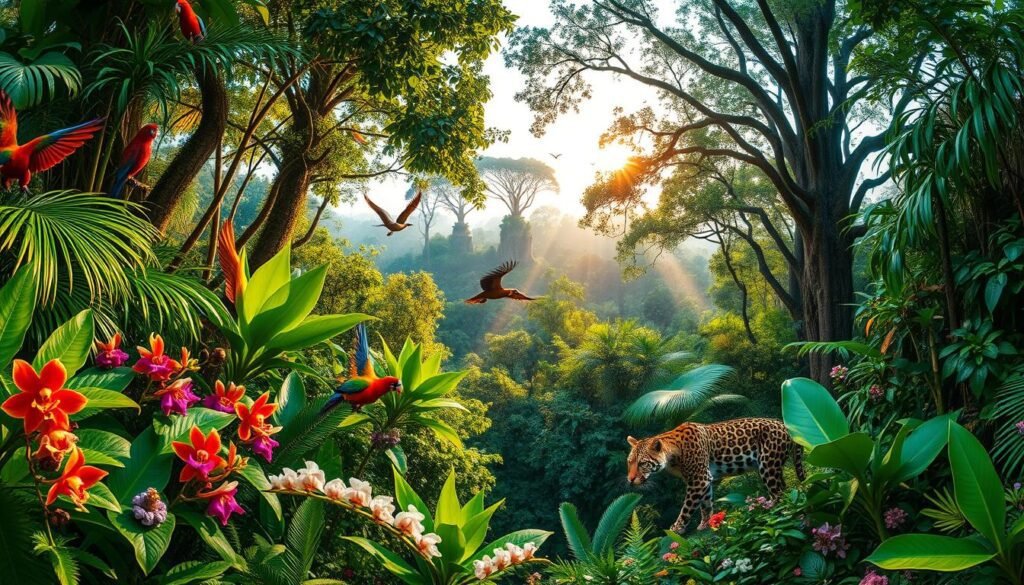
Amazon Rainforest, also commonly referred to as the lungs of the Earth, represents one of the biological systems that are most crucial on Earth. Spreading across nine sovereign states and more than 5.5 million square kilometers, Amazon is more than a jungle, more than that, it is a living and functional network which helps sustain global weather patterns, biodiversity and carbon balance. Due to the growing fears about global climate change and extinction, there is an immediate need to develop a full comprehension of the complex dynamics of the Amazon.
2. Geographic and Climatic Importance
The Amazon Basin is located in South America with the greater bit of it stretching towards Brazil Continental South America, Peru, Colombia, Venezuela and Ecuador among other countries in the continent. The region is located at the equator (high rainfall, consistent temperatures), which provided an ideal environment that over the span of tens of millions of years has fostered an extraordinary profusion of biodiversity.
The immense forest is the factor influencing the climate of the planet due to its ability to absorb heat, moderate atmospheric humidity and reflect the solar radiation. It is also its persistent wetness that determines wind and rain patterns around the world.
3. The Rainforest’s Role in Global Carbon Cycles
The Amazon can be considered a carbon sink, trapping nearly 2 billion tons of CO 2 every year, or 5 percent of the total produced. In photosynthesis, trees in the rain forest trap and lock up carbon within their bodies in the trunk, leaves and roots. This sequestration of carbon prevents the global warming.
However, the stocks of carbon that would have been accumulated on the trees are released back to the atmosphere when trees are cut or burned hence accelerating climate change. As a result, Amazon deforestation is not only a local issue, but overseas situation.
4. Hydrological Cycle and Rain Creation
The Amazon is a dominant agent in the generating system of the hydrological cycle of South America. As a result of the process called evapotranspiration, trees release water vapour to the atmosphere sustaining:
• Precipitation in the continent;
• The water resources upon which Brazil, Argentina and Paraguay use to rely on agriculture;
• The required humidity to form the clouds and also the cooling of the regions.
The researchers have established that the release of large tree is more than 1,000 litres of water in day that outlines the tremendous significance of forest cover in the stability of meteorological situations.
Also, the Amazon provides a birth place of so-called flying rivers, which are the streams of moisture that circulate in the air above South America and affecting rainfall far beyond the forest limits.
5. Soil and Nutrient Recycling
The terrain of the Amazon though seems highly green in terms of what your eyes see, is in fact highly lacking in nutrients. It is not the substratum that is a cause of the richness of the ecosystem, however; rather, this is a process of continuous reuse:
Decomposing of dead leaves and other organic matter occurs at a high rate due to the presence of a high quantity of fungi and microorganisms.
The resultant nutrients are reabsorbed in plants having superficial roots rapidly.
Termites and ants are insects which aid aeration of soil in addition to further mixing of the soil thus enhancing fertility.
This nutrient cycle is one that is sensitive. A clear-cut forest and interrupted a cycle would contribute to the fast deterioration of exposed soil, which will make the land unusable as it could be studied in few years.
6. The Symbiotic Network of Species
In the Amazon basin, each of its entities is closely and practically interconnected:
Plants and pollinators: There are many species of plants that rely strictly on the activities of individual animals (insects and avian ones), which allow the plant to effect pollination.
Fruivores: Animals that eat fruits- Birds, and primates consume and dispersed seeds thus contributing in the renewal of the forest.
Fungi and trees Mycorrhizal fungi connect with root systems creating the underground net that exchanges nutrients, and in others, chemical signals.
Scientists refer to this vast underground system as the wood wide web, as it is comparable to an underground weblike system of life that explains how Amazonian eco systems succeed due to the system of cooperation and not competition.
7. Human Connections and Indigenous Stewardship
The Amazon rain-forest is hardly an unexplored wilderness; to it more than 400 native tribes are indigenous, some of whom have lived there for thousands of years. They have an intimate knowledge of the terrain to include:
Children and youth ecologically sound hunting and fishing
• Use of medicines plantorous
Slash-and-mulch agriculture, environmentally friendly approach that will help regenerate a forest
This can indeed be proven empirically since low rates of deforestation could be found in the areas controlled by native populations which further substantiates the significance of indigenous management in the maintenance of the integrity of the forest.
The cultural, spiritual and practical ties that these communities have with the land also adds ecological richness to the amazon that brings along with it a very important part of human heritage.
8. Emerging Threats to the Ecosystem
Despite the fact that its ecological role is priceless, the Amazon is seeing its challenges accumulate:
• Deforestation: Driven majorly by cattle ranching, soy production, and logging of timber on illegal basis
• FIRES: Naturally occurring and human-made fires have further become intense due to forest clearance
• Mining: The mining businesses pollute rivers and destroy biological diversity
• Climate Change: The increases in temperature as well as diminished precipitation exert an escalating pressure on the forest ratios
• Invasive species: Human causalities induce interference with the autochthonous habitat
There has been the warning by scientists of such a critical threshold, a point where the rain forest can not sustain itself any more and might transform to a savannah like environment. In case this happens, large amounts of CO 2 would escape and the resultant effect would be disastrous to the diversity of the world.
9. Conclusion
The Amazon Rainforest is not just a wonderful green carpet but a key ecosystem, without which there is not any guarantee of existence of loads of biodiversity in the world. It has trees that add value to the environment, rivers that propagate continent-sized expanses, and species that signify the results of the time evolution that spans millions of years.
In order to fathom what needs to be done to protect the Amazon is to understand what it takes in order to ensure that we will continue to live. Each cut down tree, or poisoned river not only is killing the forest, but the world we all live in, share. Due to severe climate change, preservation of the Amazon is neither optional, but rather a necessity.
The lessons being drawn of the forest, as life continues to make more research discoveries on the importance of the forest as a vital ecosystem, it has become more evident that, the Amazon is the savior of the balance and sustainable future environment of all ecosystems.